Advanced course

Every Product Needs a Role

Do you evaluate every product by the same criterion?

A product may be growing, serve a particular customer occasion or play an important commercial role. But one criterion cannot tell you what every product really contributes to the portfolio as a whole.

Follow GoodDay Foods as the team moves beyond evaluating products in isolation and starts asking what role each product is supposed to play in the portfolio, what evidence would show that the product is really playing that role and whether the product still justifies its place.

6 chaptersCourse CompanionEnglish80 USD + applicable tax
Course chapter
Course chapter preview
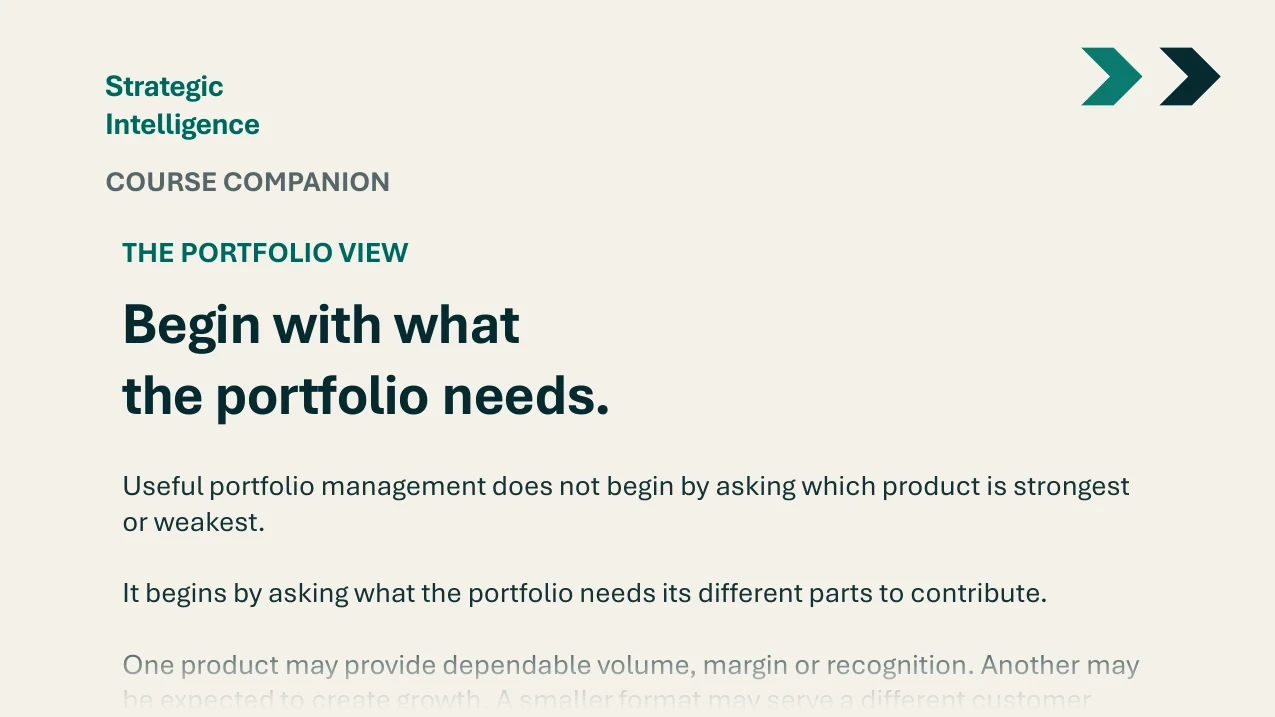
Course Companion
Course Companion preview

What you will learn

See why a portfolio should not be evaluated using one universal criterion applied in the same way to every product.

Learn how to define the role a product is expected to play, determine what would need to be true for the product to genuinely play that role, identify evidence that supports or challenges it, and assess the product in the context of the wider portfolio.

The relevant evidence will differ depending on the product’s role, the portfolio and the particular business situation. The important discipline is to define the expected contribution first — and then test whether the available evidence supports it.

The question is not whether every product performs well by the same criterion, but whether each product genuinely contributes what the portfolio needs from it.

How the course works

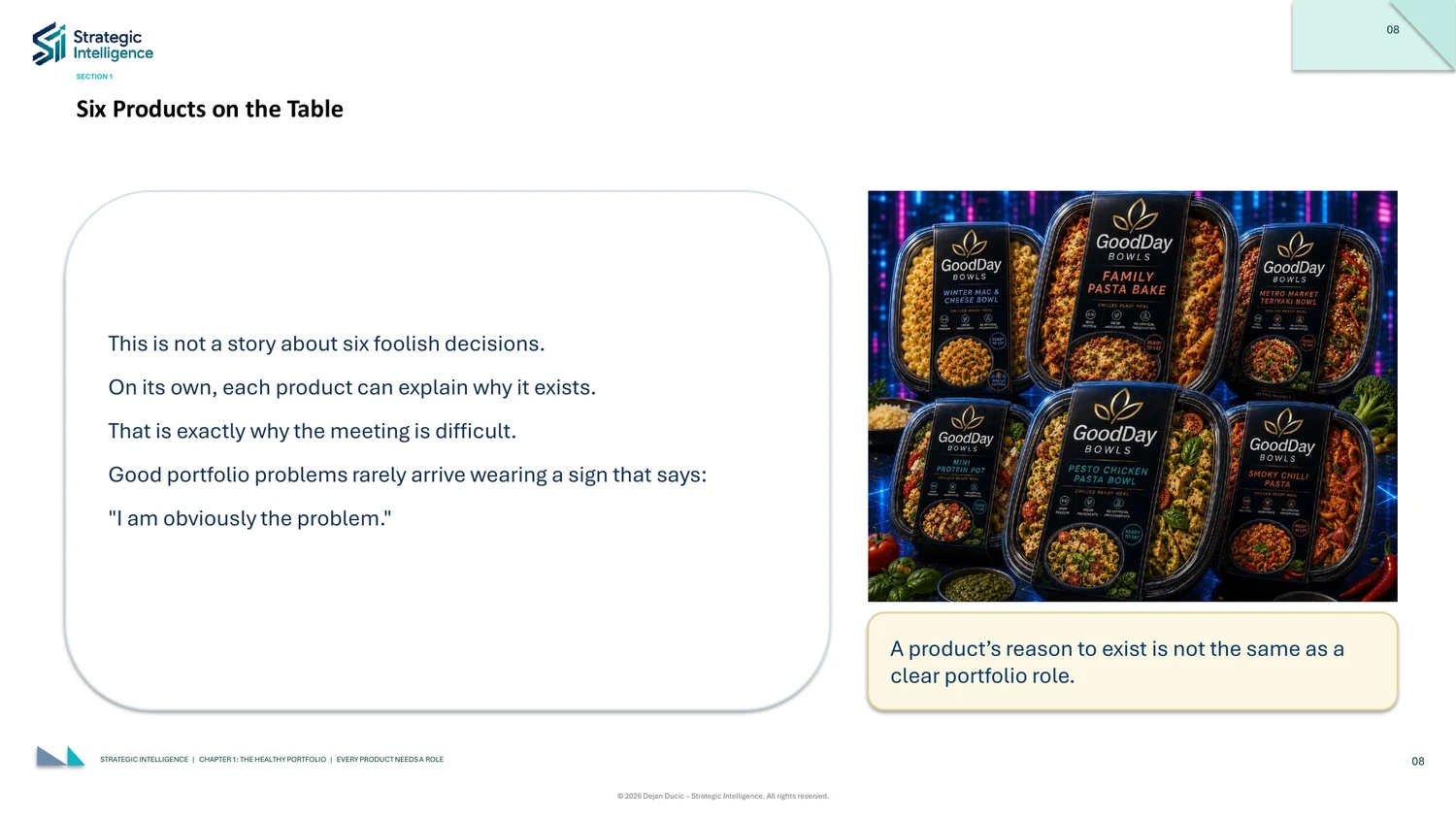
First, investigate the GoodDay Foods portfolio.

Six chapters follow the team as it moves from finding reasons to keep each product to testing whether those reasons really justify its place in the portfolio.

The journey through the chapters

Chapter 1 — The Portfolio That Looks Healthy from Far Away

The GoodDay Foods portfolio is still growing slightly, but warning signs are appearing underneath: lower margins, greater reliance on promotions and weaker repeat purchasing. The chapter raises the question of whether that growth is actually healthy.

Chapter 2 — Every Product Has a Defence

Move from portfolio-level symptoms to product-level evidence and distinguish the arguments used to defend a product from the contribution the portfolio actually needs.

Chapter 3 — Is Growth Growing the Portfolio?

Test whether a growing product is creating useful growth for the portfolio or simply growing itself.

Chapter 4 — Does the Product Earn the Occasion?

Examine products designed for new customer occasions and ask whether the evidence supports the occasion they claim to serve.

Chapter 5 — When Exceptions Become Permanent Complexity

Look at products kept for special commercial or seasonal reasons and ask when a justified exception becomes permanent portfolio complexity.

Chapter 6 — Every Product Needs a Role

Bring the evidence together, clarify what each product is expected to contribute and move from describing the portfolio to actively managing it.

Then use the Course Companion

The course investigates one portfolio.

The Course Companion explains how to test whether each part still deserves its place.

The Companion does not repeat the GoodDay Foods investigation.

It starts with what the portfolio needs, looks at what each product is expected to contribute, what evidence supports that contribution and what complexity comes with keeping it.

The logic introduced in the course helps you assess different types of portfolios based on what they are actually expected to contribute.

What you receive

6 chapter PDFs + Course Companion + Read Me First

The course uses a visual, slide-style PDF format designed primarily for laptop, desktop or tablet. Mobile reading is also possible.

6 chaptersThe main story-led course.
Course CompanionThe reasoning, explained for reuse.
PDF formatDesigned for laptop, desktop or tablet.

Try Chapter 1 first

See how the course actually works before you buy it.

Chapter 1 is the actual opening of the course. It introduces the GoodDay Foods portfolio: sales are still growing slightly, but lower margins, greater reliance on promotions and weaker repeat purchasing raise the question of whether that growth is actually healthy.

It also lets you experience the course’s visual style, language and way of explaining ideas.

You do not need to enter an email address to download it.

Preview of the free Chapter 1

Language

English

Also available in Czech: Každý produkt potřebuje svou roli

Purchase the course

80 USD + applicable tax

Continue to Gumroad. The final amount, including any applicable tax, is shown before payment.